Canadian Children’s Book Centre presents: a Get Published Seminar

For those of you who are in or near Toronto and want to write for kids or teens, don’t miss

THE CANADIAN CHILDREN’S BOOK CENTRE PRESENTS: GET PUBLISHED! SEMINAR

TORONTO, SEPTEMBER 1, 2011: On September 17, 2011 in Toronto, three panels of
experts will discuss how children’s books are written, illustrated, edited,
and selected for publication and sale in Canada. There will also be a question
and answer period where panel experts will discuss participants’ questions.
CREATORS SHARE THEIR EXPERIENCE: Award-winning authors Barbara Reid
(children’s books), Gillian O’Reilly (non-fiction), and a third fiction writer
(TBA) will talk about the creative process and how their careers took off.

PUBLISHERS TELL ALL: Margie Wolfe (Publisher, Second Story Press) and Sheba
Meland (formerly Publisher of Maple Tree Press) give the inside scoop on the
children’s publishing industry and what publishers are really looking for in a
manuscript.

BOOKSELLERS REVEAL THE INs AND OUTs OF BOOKSELLING:
Highly successful wholesaler Maria Martella (owner of Tinlids Inc.) and sales
executive Saffron Beckwith (Vice President of Kate Walker & Co.) explain how
booksellers decide which books to showcase in their stores.

WHEN: Saturday September 17, 2011
9:00am to 12:00pm
WHERE: Canadian Children’s Book Centre
Room 222
2nd Floor, Northern District Library
40 Orchard View Blvd
(One Block North of Yonge and Eglinton)

COST: $75 per participant (includes the CCBC’s best-selling ‘Get Published!’
kit)

Registration is limited. Please register with Dawn Todd by phone at
416.975.0010 ext. 224 or online at
www.bookcentre.ca/store/products/get_published_seminar by Thursday September
15, 2011.

All proceeds go to the Canadian Children’s Book Centre, a national, not-for-
profit organization founded in 1976 to encourage, promote, and support the
reading, writing, and illustrating of Canadian Children’s literature.

For further information contact:

Dawn Todd, General Manager
Canadian Children’s Book Centre
416 975-0010 ext. 224
dawn@bookcentre.ca
Getting Out of the Slush Pile

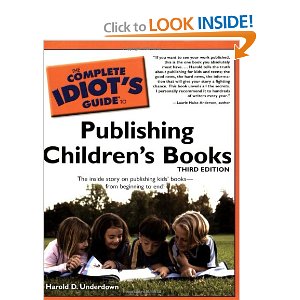
Recently, I’ve had several emails from writers desperate to get published.  Sadly, I find most of the writers who contact me know little about the business of writing for children…and it really is a business.  You might as well know that now people.  No one is going to publish you because you’ve written a story that your children love, or one that your students adored.  No one is going to publish a story because it teaches children an important lesson.  Publishers want stories that they can sell, stories with a fresh take on a universal subject, stories that are stand head and shoulders above the usual.  Those stories may have a lesson imbedded in them, but the lesson serves the story, not the other way around.  The first thing I ask these writers is “When was the last time you read a children’s book?  Many refer to classic stories from their childhood.  Most haven’t a clue what is going on in children’s publishing today.  I immediately send them to the library and local bookstore to read award winning books, I encourage them to join or form critique groups to really work on their writing skills, and I send them to Harold Underdown, an editor, and the author of The Complete Idiots Guide to Publishing Children’s Books.  In addition to the book, Underdown has lots of material on the web that can help wanna-be’s.  Check out Getting Out of the Slush Pile.

 So if you’re one of those writers, do us both a favor, and get your butt down to the bookstore, and to the library, start a critique group and start looking at your work critically…and check out Harold Underdown’s site…There are no shortcuts.  You just have to put in the hard work.  You have to revise your story until it is  perfect.  You have to become the best writer you can be. But, I  guarantee that you won’t regret it, and who knows, you might even find you’ll work your way out of the slushpile.

NYT article on Boys and Reading

Here’s an interesting article on boys and reading in the NYT.  The thing that puzzles me though is that there are some really fabulous male writers these days who are writing for kids and teens…Walter Dean Myers, M.T. Anderson, Art Slade, and Jon Scieszka to name a few.  Why are we still not doing well in keeping boys reading?

Enjoying a Good Rejection Story

Everyone in the writing community knows that rejection is part of the business and that if you can’t handle it you might as well start looking for a new career. Maybe that’s why rejection stories are traded so frequently among writers.  We’ve all heard about how an impoverished, single mom (JK Rowlings) worked away on her first Harry Potter manuscript which was rejected no less than nine times before going viral.  I’ll bet some of the larger publishing houses are still kicking themselves over that one!

But, here’s one I hadn’t heard.  According to a guest post by D.L. Orton over at Pimp my Novel,

Stephen King received 30 rejections for his novel Carrie before throwing it in the trash. His wife retrieved it, and convinced him to keep trying. The editor from Doubleday who finally bought the book had to send King a telegram because his phone had been disconnected.

Even though I’m not a huge Stephen King fan (his stuff is just too scary for my taste), you gotta love hearing that a whole lot of publishers missed the boat.

Remember that it only takes one publisher to fall in love with your manuscript and even the best have been rejected so you’re in good company.  Keep revising.  Keep sending it out.  And, if you hit  your rejection saturation point, toss it in a drawer instead of the trash (or in this day and  age, the recycling box) and get on with your next project!  Orton’s website title sums it up: Just Write.

YA Highway

One of the blogs I really enjoy reading regularly is YA Highway, which has a number of contributors from near and far. I find the postings diverse, interesting, challenging, and sometimes quite funny.  One recent post that caught my eye was Kristin Briana Otts’ Edgy Stereotypes Which Will Not Actually Make Your Characters More Edgy post.  I loved it as I’ve been reading too many books lately with characters who are supposed to be edgy because they have  a few tattoos or a punk haircut.  I mean, the guy at my local hardware store (anyone with an old house is likely to get to know the staff at the local hardware store quite well)  has a wild haircut but  he also has a 9-5 regular job…HIS HAIRCUT DOES NOT MAKE HIM EDGY!

If you’re interested in writing for the young adult market,  you’ll definitely want to check this post out.  

Writer’s Digest contests

Do you write thrillers, romance, mysteries or for the young adult market?   Are you a writer dying to get discovered? If so, check out
Writer’s Digest who just happen to have a series of contests coming up. There are other contest categories too, so don’t miss out.

The Blood-Red Pencil: 10 Reasons Writers Might Drink

Sometimes writing is so frustrating that you just want to throw the towel in, or at least have a nice glass of chardonay…If you’re having one of those days, check out The Blood-Red Pencil: 10 Reasons Writers Might Drink.  It’ll make you laugh, and you might not even need that drink!

PIcture Book Webinar with Mary Kole

On Thursday July 28, Mary Kole is offering a Picture Book Webinar.  Mary is an agent with Andrea Brown, teaches webinars for Writer’s Digest, and hosts a fabulous blog. If you’re trying to break into the picture book scene, you won’t want to miss this one, especially since she’s offering a picture book critique for no extra cost.  It’s a steal people!

Writing help from a pro

Getting Started

Like most other professional writers with a focus on books for kids and teens, I’m frequently asked by family and friends to look at their stories and/or help them get published.  But, writing a cute story simply isn’t enough. Most amateurs aren’t aware of just how much time, effort, and work goes into getting published, especially these days.  Even very short manuscripts can require a dozen rewrites, and of course you have to find a publisher interested enough to take a chance on your work.  Writing for kids is not something you can do just because you’ve got a little retirement time on your hands.  It takes knowledge about the industry and a commitment to the craft of writing. Even if you decide to opt for the self-published route, you still need to follow the previous steps, but in addition, you will also need to find the services of a professional editor, designer, and illustrator or photographer for your book’s cover (and, if necessary, interiors), possibly a computer expert (if you are going the e-book route) and you’ll still need someone to handle promotion and sales.

If all this is sounding a little overwhelming, you may want to check out Harold Underdown’s “Getting Started” pages.  Underdown, is a former editor, and the author of The Complet Idiot’s Guide to Children’s Publishing.


His advice is solid gold

Next Newer Entries